
Titan, the Echo of Primitive Earth
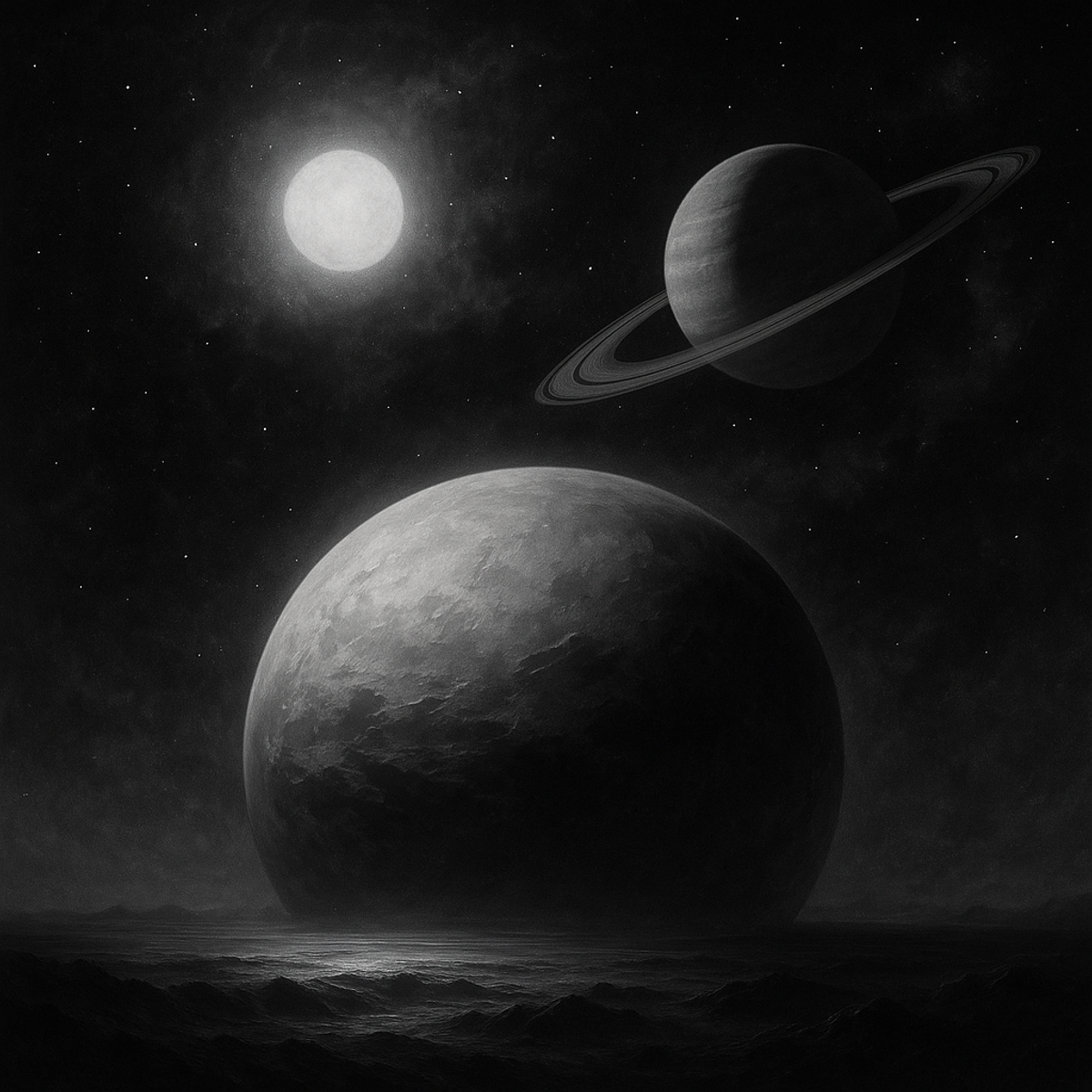
Explore Titan, Saturn's fascinating moon that mirrors primitive Earth in many ways, offering clues about the origin of life.
A Glimpse at Titan
Titan is Saturn's largest moon and the second largest in the solar system, surpassed only by Ganymede. What makes this moon truly exceptional is its dense, nitrogen-rich atmosphere, something it shares only with our planet in the solar system. Thanks to space missions and collected data, we know that Titan holds surprising similarities to primitive Earth, when our world was just beginning to forge an environment suitable for life.
Scientists have focused their attention on this fascinating moon, eager to unravel its mysteries. With mountains, lakes, and rivers, Titan is not only intriguing for its physical features but also for how it might help us understand the beginnings of our own home.
The Nitrogen-Rich Atmosphere
Titan's dense atmosphere is primarily composed of nitrogen, similar to that of our Earth. However, what sets it apart is the presence of complex hydrocarbons. The methane and ethane clouds in Titan's atmosphere create a unique circumstance: rain and liquid rivers form on its surface, although these are not made of water, but of methane.
This thick, hazy atmosphere acts as a protective mantle and, much like on primitive Earth, it's possible that complex chemical reactions are taking place within its thickness, evoking the processes that led to the formation of essential organic compounds on our planet.
The Surface and Its Mysteries
Titan presents a landscape of mountains, dunes, and hydrocarbon seas. The Huygens lander, which touched down on Titan's surface in 2005, provided direct images that revealed this complex geological diversity. The vast deserts of sand dunes, similar to those on Earth, are carved by titanic winds, and the methane and ethane seas polish the surface with their liquid flow.
One of the most discussed aspects is the possibility of cryovolcanism. Instead of molten lava, cryovolcanoes would eject frozen water and ammonia, enriching the surface with this vital compound, which could play a crucial role in prebiotic chemistry.
Echoes of an Ancient Earth
Titan closely resembles an archaic Earth, where life was still taking its first steps. In those times, our planet's atmosphere was also dense and laden with gases like nitrogen. Studying these similarities provides us with a window into the past and can reveal clues about Earth's atmospheric and geological evolution.
The analysis of Titan also helps us understand the forces that shape planetary and lunar atmospheres, supporting us in contemplating how other celestial bodies might harbor conditions similar to those of our ancient world.
Titan and the Search for Life
The interest in Titan goes beyond its similarities to Earth. The possibility that it might harbor forms of life, even in its simplest form, is an exciting question. Despite the low temperatures, the subsurface oceans of water could offer a warm and chemically active refuge, ideal for the emergence of microbial life.
Scientists continue to explore this possibility, planning future missions that could allow us to learn more about its biological potential. The enigma of Titan is vast in its promises and captivates both dreamers and scientists, motivating new generations to seek answers to one of the deepest mysteries of the cosmos.

Free Birth Chart
Discover the sky that existed when you were born
We reconstruct the astronomical map of the moment of your birth with exact planetary positions and advanced interpretation.
Get your free chart